

Navigating the AI-Driven Repricing of Software and Business Services
Key Takeaways
1. The selloff is real. The equivalence is false.
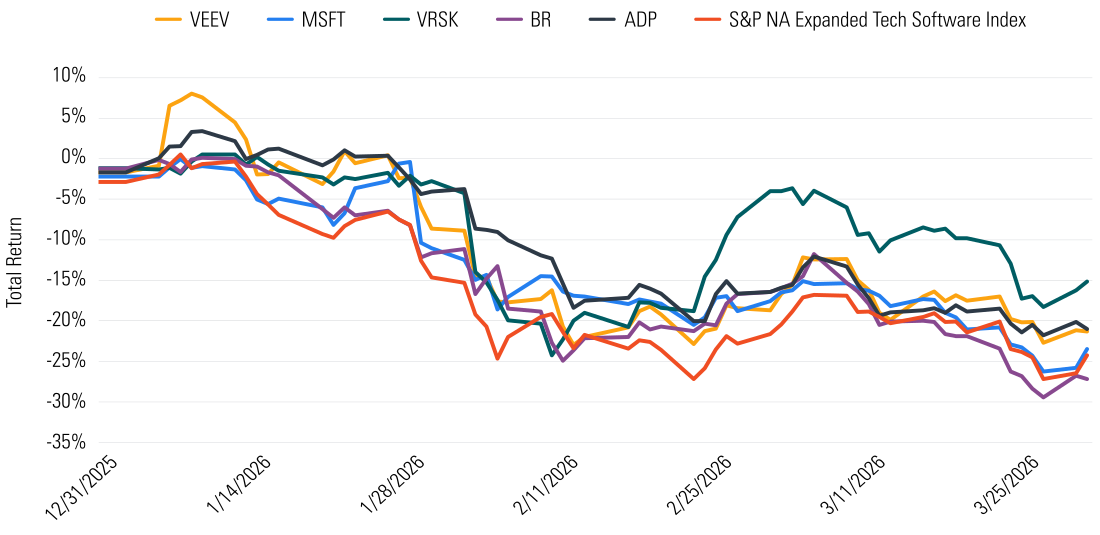
The S&P North American Expanded Technology Software Index fell 24.2% in Q1 2026, compared to a 4.4% decline in the
S&P 500 Index. Markets have priced Artificial Intelligence (AI) disruption as largely uniform across software and business
services, with little distinction between structurally sound businesses and genuinely impaired companies.
2. Uncertainty vs. Risk
Uncertainty is rampant in the AI era, as the market discounts an increasingly wide range of outcomes. Risk indicates real fundamental impairment to a given business and permanent capital impairment. For most of our portfolio holdings, as of this writing, our analysis points to the former, where patient, long-term investors have historically been rewarded.
3. We added to three businesses whose moats AI strengthens.
Verisk, Broadridge, and Veeva each hold proprietary data tied to regulatory requirements and mission-critical workflows, making these companies likely beneficiaries of AI rather than targets of it. We added to each during the quarter.
4. Microsoft — Likely AI winner caught up in the selloff.
Microsoft remains one of our largest positions. We believe the selloff reflects a misinterpretation surrounding Microsoft’s AI strategy as it converts its large installed base of enterprise relationships into an AI distribution advantage, while the company navigates its seat-based model transition. Long-term, we see Microsoft as an AI winner.
5. We exited ADP where risk outweighed opportunity.
With competitive advantages, including high switching costs, directionally eroding in the AI era alongside increasingly capable competitors, we used ADP sale proceeds to reallocate to the three additions profiled above where competitive advantages are reinforced and amplified by AI through unique and proprietary data, regulatory lock-in, and mission-critical workflow embeddedness.
The Setup: A Fear-Induced False Equivalence
The past three months saw one of the sharper selloffs in software and business services in recent memory. We believe the primary cause was Anthropic’s announcement of the expansion of its Claude platform into agentic desktop automation. A viral research note from Citrini Research positing a dystopian scenario in which rapid AI adoption causes mass white-collar displacement and a deflationary economic spiral arguably contributed to the selloff. While Citrini’s note was explicitly framed as a scenario exercise, not a forecast, markets took it more seriously.
The result was indiscriminate selling pressure, with the S&P North American Expanded Technology Software Index, the benchmark most directly reflecting this software and business services universe, declining 24.2% in the first quarter.
In a broad selloff like this, our experience is correlations rise and distinctions collapse. Stocks trade as a category, with less attention paid to the differences among the underlying businesses by market participants in the short run.
Chart 1
Q1 2026 Indiscriminate Software and Business Services Selloff
Source: Bloomberg; data as of March 31, 2026.
We witnessed this firsthand across our portfolio and the quality investable universe encompassing businesses able to produce a minimum of 15% return on equity (ROE) for ten consecutive years. The volatility in Q1 created a false equivalence, treating most software and business services companies as subject to similar AI disruption risk even though the competitive positions of many of these businesses are structurally different in material and important ways for long-term investors.
The question worth asking is not whether AI will change software. It will. The question is which businesses may emerge stronger, which may become permanently impaired, and which are simply being buffeted by sentiment that has not yet distinguished between them.
The analytical rigor that drove portfolio action in Q1 is the focus of this piece as we navigate uncertainties and risks present in the current environment. As always, we continually refine our thinking of the businesses and investment opportunities within our investable universe.
What We Bought and Why
The Jensen Quality Growth Strategy added to three businesses during the quarter: Verisk Analytics, Broadridge Financial Solutions, and Veeva Systems. All three cases share certain key attributes, including proprietary data, regulatory lock-in, and workflow embeddedness as sources of competitive advantage, where we believe AI amplifies rather than erodes the moat. AI models are only as capable as the data they draw upon. That makes non-replicable, proprietary data more valuable in the AI era, not less, while regulatory and workflow lock-in enhance financial and procedural switching costs.
Portfolio Actions at a Glance
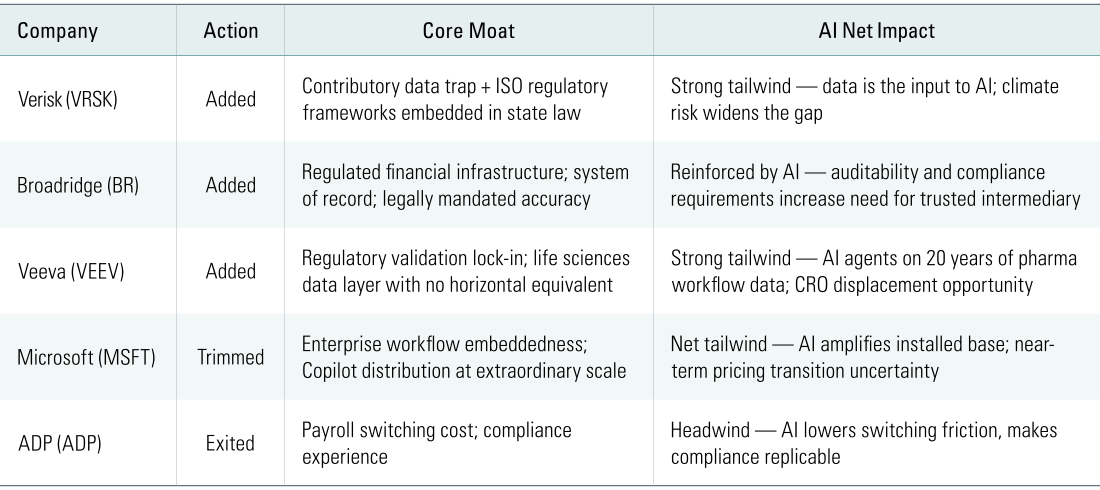
Verisk Analytics (VRSK) holds what is arguably one of the most structurally defensible positions in our coverage universe. Its Insurance Services business operates on a contributory “give-to-get” model, where insurance carriers supply premium and claims data to Verisk in exchange for access to an industry-wide loss pool that anchors actuarial models, rate filings, and catastrophe pricing, helping insurers better understand and price risk. Exit from this contributory model is theoretically possible but practically untenable, since an insurer that stops contributing to Verisk’s database loses access to the broadest repository of P&C loss experience that exists, thereby putting their underwriting at a structural disadvantage to peers who continue their mutually beneficial relationship with Verisk.
This lock-in operates on two levels. The contributory data pool creates competitive lock-in, while Verisk’s ISO standardized forms and rating frameworks, incorporated into state regulatory processes, create legal and administrative embeddedness that no amount of capital can replicate quickly.
Verisk, acting as a centralized partner that connects stakeholders throughout the insurance industry, should be well positioned to take advantage of AI rather than falling victim. Cleaner, more robust data sets from insurers create an opportunity to expand Verisk’s insurance consortium beyond its traditional reach, into areas like Excess and Surplus, Life, and international insurance markets. Catastrophe modeling is among the most data-intensive applications of machine learning that exist. Verisk’s over 50 years of longitudinal data in underrepresented perils like wildfire, flood, and convective storm further enhances its value as climate risk reshapes loss distributions. And regulatory frameworks for AI in insurance rely on Verisk’s input to protect its clients’ data and ensure safe and ethical use, offering another example of how embedded Verisk is into insurance industry workflow.
Given Verisk’s inclusion in the software-related selloff, we opportunistically added to the position during the quarter.
Broadridge Financial Solutions (BR), in our view, is a business that is broadly classified as a professional services firm, a categorization that seems to be contributing to recent mispricing, since unlike Broadridge, we do see many professional services businesses facing genuine AI disruption risk, representing a potential “baby out with the bathwater” situation in Broadridge’s case.
We view Broadridge as a regulated financial infrastructure and software platform, operating as the system of record and authoritative source of record that the financial system depends upon for proxy voting, investor communications, and post-trade settlement across most U.S. broker-dealers and asset managers. Its Investor Communications segment, which accounts for approximately 70% of consolidated revenues, is legally mandated and subject to continuous regulatory audit.
Management recently indicated that “99% accuracy would put us out of business,” a concise explanation of why AI disintermediation risk here is structurally limited. Increased AI usage across the financial system is likely to increase — rather than diminish — the need for a trusted, auditable intermediary. In our view, Broadridge is in a unique position to serve that role.
“Increased AI usage across the financial system is likely to increase — rather than diminish — the need for a trusted, auditable intermediary.”
The primary uncertainty relates to the future of tokenization, or the issuance and transfer of securities on blockchain-based infrastructure, which remains largely theoretical today and not yet meaningfully implemented at scale, yet offering a wide range of potential outcomes. The SEC’s stance that even tokenized securities are still securities and subject to existing regulatory frameworks likely preserves Broadridge’s role as the authoritative source of record for the financial system broadly, but it’s an area worth monitoring closely as use cases evolve.
We took advantage of weakness in its share price to add to Broadridge given its robust and underappreciated strengths.
Veeva Systems (VEEV) is the leading provider of cloud software to the global life sciences industry, offering specialized applications across commercial, clinical, regulatory, and quality functions. Built originally on Salesforce and now operating on its own platform, Veeva has achieved deep vertical penetration among top biopharma companies in mission-critical areas like regulatory and clinical trial software.
Veeva has been perhaps the clearest example of short-term price weakness dislocating from long-term fundamentals, as investor attention appears to be focused on two primary concerns: Salesforce competing in life sciences CRM following the two companies’ separation agreement, and AI-related software concerns relating to Veeva’s future growth.
Regarding the first concern, Veeva announced in December 2022 and then formalized in September 2025 its separation agreement with Salesforce. We think the strategic rationale for the separation was sound, as remaining on a competitor’s infrastructure could constrain product velocity and limit platform control. Therefore, we view it as a sensible long-term risk mitigation strategy while maintaining strategic flexibility, with some customer churn worth it over the long run.
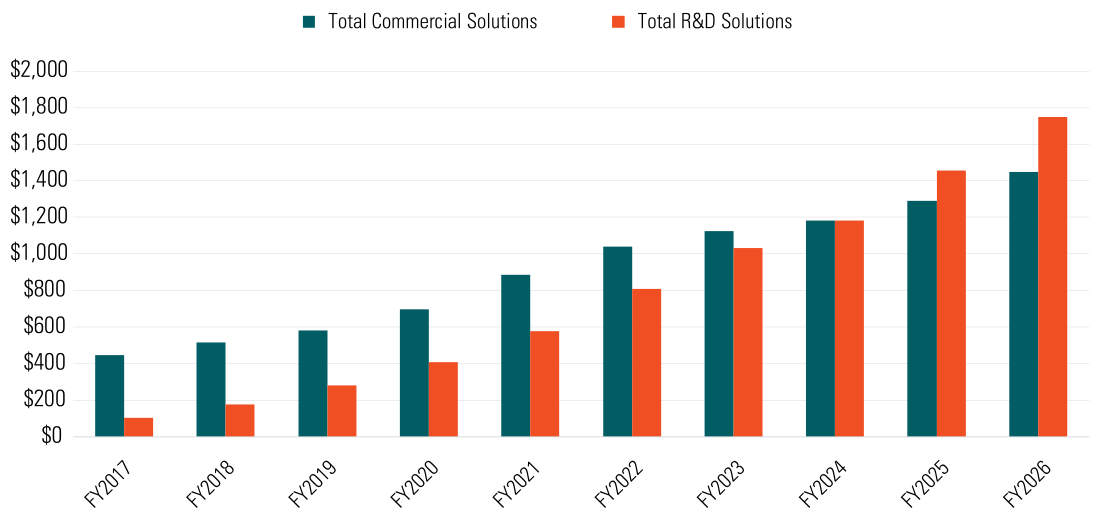
While commercial CRM competition has garnered much investor attention, and it is an important consideration, it distracts from the real crux of the long-term investment thesis for the company. Specifically, we view Veeva as more of a critical infrastructure provider than a software company, where its Vault R&D platform orchestrates mission-critical workflows as the de facto operating system for the industry, reported within Veeva’s R&D Solutions segment.
Chart 2
Veeva Systems Revenue by Segment 2017-2026 ($MM)
Source: Bloomberg; data as of April 24, 2026.
Veeva’s R&D Solutions segment was only $103 million in revenue in 2017, representing less than 20% of total sales. Over the past nine years, R&D Solutions has grown to represent over 54.7% of total revenues, whereas CRM, a component of Total Commercial Solutions, is estimated at 20% of total sales. Importantly, R&D Solutions remains Veeva’s core growth and profit engine, where it holds not only its strongest competitive advantages but also carries higher growth potential and margin profile than Commercial Solutions. Investors’ focus on the CRM side of the business, while rational, may be obfuscating the favorable long-term prospects for R&D Solutions in particular and the company overall.
On the second point, we view Veeva’s AI positioning as structurally superior to most software companies due to unique proprietary data serving as the input to AI, including 20 years of longitudinal life sciences-specific workflow data spanning clinical trial records, regulatory submissions, quality documentation, and adverse event reports that provide a context layer no foundation model can replicate without Veeva’s cooperation. This data, coupled with embedded regulatory validation and audit trails existing within workflows, result in high switching costs and may enable Veeva to serve as a key enabler for AI tools and functionality for the life sciences industry.
As of Q1 quarter-end, Veeva traded at under 20x forward earnings and 16x trailing EV/FCF, both below the S&P 500’s average multiple despite Veeva’s superior quality profile, a business with free cash flow margins above 40%, no gross debt, over $5 billion in net cash, and a dominant moat in a non-discretionary end market.
This is precisely the kind of investment opportunity our demanding ROE threshold and rigorous investment process is designed to identify — a business with a durable and improving competitive position whose stock has been caught in a sentiment-driven selloff that can be exploited by long-term investors.
We increased our exposure to Veeva in the quarter at a steep discount to our estimate of intrinsic value.
Microsoft: A Likely AI Winner Caught in the Selloff
Microsoft (MSFT) remains one of our largest portfolio positions and since our initial investment in 2005 it has been one of the largest contributors to performance. However, Microsoft declined roughly in-line with the broader software selloff during the first quarter, which warrants further review.
In our view, the selloff in Microsoft alongside the broader software universe reflects a fundamental misinterpretation of its AI positioning. Instead of being directly threatened by AI, we believe Microsoft remains one of the best businesses positioned to benefit from AI at scale.
While perhaps obvious, it’s worth highlighting that Microsoft’s Copilot is not a standalone AI product competing for new customers. Rather, it is an AI capability embedded into the Microsoft 365 ecosystem already used and integrated into existing workflows by Microsoft’s enterprise customers. In addition to the technological challenge of producing viable competing offerings to Microsoft’s suite of services, a new competitor faces the entrenched habits, compliance infrastructure, and IT governance structures of potential enterprise customers. As AI becomes more capable, Copilot’s entrenched position strengthens, potentially adding to already robust switching costs. Microsoft’s most recent quarterly results delivered revenue growth of 15% year-over-year alongside continued Azure expansion — results consistent with AI amplifying rather than threatening the core franchise.
Instead of being directly threatened by AI, we believe Microsoft remains one of the best businesses positioned to benefit from AI at scale.”
The salient near-term question for Microsoft is not whether its moat is durable, but whether the transition from seat-based to consumption-based pricing — which AI is accelerating across enterprise software — introduces revenue volatility even as the long-term outlook strengthens. We believe it does, which helped inform the decision to trim the position during the period, while remaining one of our largest positions at quarter end.
Microsoft has navigated comparable business model transitions before, including the shift from perpetual licenses to cloud subscriptions. Near-term pricing model uncertainty is not the same as long-term franchise risk. We trimmed while our long-term conviction remains very much intact.
ADP: Why We Exited
ADP (ADP) is a leading provider of payroll, human capital management, and business outsourcing solutions. While we do not believe the business is impaired in the short run, our long-term conviction in the business and investment merits gradually deteriorated over the past 18 months as competition intensified and the company’s long-term growth expectations moderated. These concerns resulted in trimming the position progressively throughout 2025 at relatively robust valuations and the decision to ultimately exit the position in Q1 2026.
ADP’s core competitive advantages, including switching costs, scale, and regulatory complexity, appear to be eroding. Cloud-native competitors have invested heavily in migration tooling and user experience, gradually reducing ADP’s differentiation, particularly in the small and medium-sized business (SMB) and mid-market segments where switching is easier and competitors can deploy features more quickly. In short, payroll processing is increasingly viewed as a standardized service, with competition building.
We believe AI also represents a structural risk, as ADP’s revenue is tied to payroll volumes and employee count. Increased automation, particularly in administrative and back-office roles, could reduce overall employment levels over time, creating an additional headwind to long-term growth.
Ultimately, the proceeds from the ADP sale were redeployed into Verisk, Broadridge, and Veeva. We believe these moves improved the overall risk-return profile of the portfolio.
What This Means for Our Clients
We continue our focus on owning attractively priced stocks of companies with durable competitive advantages and strong management teams. The current environment has not changed that discipline.
What it has done is create dislocations between price and fundamentals, several of which we acted upon during the quarter where our convictions aligned.
We continue our focus on owning attractively priced stocks of companies with durable competitive advantages and strong management teams. The current environment has not changed that discipline.”
Val Jensen, our founder, described the ideal opportunity as “double-barreled”: buying a great business at a discount to intrinsic value, capturing both the closing of that gap and the ongoing compounding of the underlying business over time, with the latter being more important over the long run. We believe that description applies to each of the three businesses we added to during the quarter. The fear-induced selloff of the first quarter created an opportunity to increase exposure to what we expect to be compelling long-term value creation in these quality growth businesses.
We hope this letter provides clarity on how we navigated a volatile first quarter in which rapid developments in AI drove a broad repricing across software and business services. The conclusions and portfolio actions discussed here reflect our assessment of that environment as of Q1 2026 and should be understood in that context.
Periods like this, where correlations rise and distinctions compress, can challenge confidence in both markets and active decision-making. In our experience, they also tend to create the widest gaps between price and underlying business value. Our focus remains on identifying those dislocations and allocating capital to businesses whose competitive advantages we believe are durable and increasingly advantaged by the changes underway.
While our analysis will continue to evolve as the landscape develops, our discipline and long-term orientation remain unchanged.
We appreciate your continued trust and look forward to updating you on our progress.
Please click here to view a list of the Jensen Quality Growth Strategy’s current holdings. Strategy holdings are subject to change.
This information is current as of the date of this publication and is subject to change at any time, based on market and other conditions.
The specific company discussions in this article are solely intended to illustrate and support the analysis and application of our investment approach and are not intended as investment recommendations or an indication that our investment decisions have been or will be profitable.
The information contained herein represents management’s current expectation of how the Jensen Quality Growth Strategy will continue to be operated in the near term; however, management’s plans and policies in this respect may change in the future. In particular, (i) policies and approaches to portfolio monitoring, risk management and asset allocation may change in the future without notice and (ii) economic, market and other conditions could cause the strategy and accounts invested in the strategy to deviate from stated investment objectives, guidelines and conclusions stated herein.
Certain information contained in this article represents or is based upon forward-looking statements, which can be identified by the use of terminology such as “may,” “will,” “should,” “expect,” “anticipate,” “target,” “project,” “estimate,” “intend,” “continue” or “believe” or the negatives thereof or other variations thereon or comparable terminology. Due to various risks and uncertainties, actual events or results or the actual performance of a client account may differ materially from those reflected or contemplated in such forward-looking statements.
Indexes are unmanaged and one cannot directly invest in an index. Past performance is no guarantee of future results.
The S&P 500 Index is a market value-weighted index consisting of 500 stocks chosen for market size, liquidity, and industry group representation.
The S&P North American Expanded Technology Software Index is a market-capitalization-weighted index maintained by S&P Dow Jones Indices. It tracks the performance of leading U.S. and Canadian companies in the software and interactive home entertainment industries, as defined by the Global Industry Classification Standard (GICS®).
Jensen Investment Management, Inc., is an investment adviser registered under the Investment Advisers Act of 1940. Registration with the SEC does not imply any level of skill or training. Although taken from reliable sources, Jensen cannot guarantee the accuracy of the information received from third parties.
© 2026 Jensen Investment Management.
Interested in Learning More?
Related Insights
Jensen News & Insights

Learn how Jensen defines quality through a disciplined focus on companies that sustain at least 15% return on equity for 10 consecutive years.

Jensen sells McDonald’s from its Quality Growth Strategy amid concerns over traffic, pricing flexibility, franchisee tension, execution and long-term growth.

The Jensen Investment Team added Intuitive Surgical to its Quality Growth Strategy, citing durable competitive advantages, earnings stability, attractive valuation and long-term growth potential.

The Jensen Investment Team added American Express to its Quality Growth Strategy based in part on the company’s resilient spending trends, strong capital returns and diversification benefits.

The Jensen U.S. Quality Index ETF brings Jensen’s longstanding quality discipline to a rules-based investment approach focused on sustained profitability.

Jensen sold its position in Meta Platforms, Inc. (META) due to concerns that rapidly increasing AI capital expenditures may not generate returns commensurate with the level of investment.