
Through the first 11 months of 2025, the S&P 500 Index posted a +17.81% return, continuing the strong market rally that began in October 2022.1 As was the case in 2024, market participants focused on increasing infrastructure spending to support the development of artificial intelligence (AI) models; albeit, with a somewhat more discerning lens into the potential returns on those investments later in the year.
Below are several key drivers behind 2025 market movements.2
Market Concentration Persisted. The ten largest S&P 500 Index weightings — Nvidia (NVDA), Microsoft (MSFT), Apple (AAPL), Alphabet (GOOGL), Amazon (AMZN), Meta Platforms (META), Broadcom (AVGO), Tesla (TSLA), Berkshire Hathaway (BRK.B), and J.P. Morgan Chase (JPM) — comprised 38.29% of the Index, generated an average total return of 27.66%, and accounted 55.40% of the Index’s total return.3
Broadening AI Trade. Recognizing the importance of ancillary technology products used in data centers for memory and storage, the market advance expanded outside of the consensus AI winners to reward lesser known beneficiaries such as Western Digital (WDC, +263.56%), Seagate Technology (STX, +225.84%), and Micron Technology (MU, +181.80%).4
Brief Volatility Bout. After strong returns in 2023 and 2024, markets saw a brief resurgence of volatility in early 2025 as trade policy disruptions unsettled investors. Uncertainty around supply chains and margins drove sharp but temporary repricing. As policy fears eased, market strength and risk appetite quickly reasserted themselves, in our view highlighting intact underlying fundamentals.
Earnings Growth Acceleration. After increasing 9.29% in 2024, earnings for S&P 500 companies are predicted to rise by 13.02% and 16.88% in 2025 and 2026, respectively.5 The step-up in forecasted growth is led in part by higher expectations for IT and Healthcare sector businesses and could create a favorable backdrop for further stock price advances in 2026.
Supportive U.S. Monetary Policy. The U.S. Federal Reserve maintained a cautious, data-dependent stance in 2025, balancing easing inflation against resilient growth and labor markets. Policy normalization progressed gradually, keeping financial conditions relatively supportive and allowing continued stock price appreciation.
2025 Jensen Quality Growth Fund Relative Performance and Key Holdings
In the first eleven months of 2025, the Jensen Quality Growth Fund I Shares (“Fund”) produced a total net return of 5.57% on an absolute basis.* However, Fund performance lagged that of the S&P 500 Index by 12.23 percentage points.
*Jensen Quality Growth Fund Performance (net of fees, as of 12/31/25)
Class I Shares (JENIX): 1 year: 5.00%, 5 year: 8.10%, 10 year: 12.40%.
The I Shares annual operating expense ratio is 0.60% as of 09/30/25.
Performance data quoted represents past performance; past performance does not guarantee future results. Performance figures shown for periods over one year are annualized. The investment return and principal value of an investment will fluctuate so that an investor’s shares, when redeemed, may be worth more or less than their original cost. Current performance of the Fund may be lower or higher than the performance quoted. To obtain updated performance information that is current as of the most recent month end, please call 1.800.992.4144 or visit www.jenseninvestment.com.
Our analysis of relative performance attribution for this period highlights the following.
2025 Top Individual Relative Stock Contributors
| Portfolio / Benchmark Weight | Portfolio / Benchmark Weight | |||
|---|---|---|---|---|
| Company Name | 2025 Total Return* | JENIX | S&P 500 Index | Total Effect** |
| KLA Corp | 88.15% | 4.03% | 0.22% | 1.72% |
| Amphenol | 104.05% | 1.96% | 0.22% | 0.82% |
| Eli Lilly and Co | 40.34% | 1.73% | 1.22% | 0.76% |
Source: LSEG, data as of 11/30/2025.
*Total return calculations through the first 11 months of 2025.
**Total effect incorporates the relative performance impact of differences in total returns and sector weights.
KLA Corporation (KLAC) is a leading global semiconductor production equipment manufacturer, specializing in process control tools that detect and reduce defects in advanced chip manufacturing. The share price advance in 2025 reflects growing investor recognition of KLA’s pricing power, structural growth, and mission-critical role in advanced semiconductor fabrication. We reduced the position during the year in order to capture strong gains, but the company remains a core portfolio holding.
Amphenol (APH) is a designer and manufacturer of interconnect systems, sensors and broadband cable. In our view, the company benefits from a strong competitive position across a diverse range of end markets. In 2025, Amphenol shares rallied in response to accelerating financial results in its data center end market, fueled by AI-related demand. We trimmed shares throughout the year and ultimately sold the position due to heightened stock price valuation. We continue to closely monitor the stock and could reestablish a position should its valuation improve.
Eli Lilly and Co (LLY) is a leading global pharmaceutical company with a broad portfolio spanning diabetes, obesity, oncology, and immunology. The investment case reflects a market-leading position in diabetes and weight loss therapeutics addressing significant unmet need, a deep pipeline aimed at sustaining this leadership position, and a strong execution track record. Eli Lilly shares rallied since we initiated the position in June 2025 due to strong financial results from its current portfolio and encouraging pipeline developments.
2025 Top Individual Relative Stock Detractors
| Portfolio / Benchmark Weight | Portfolio / Benchmark Weight | |||
|---|---|---|---|---|
| Company Name | 2025 Total Return* | JENIX | S&P 500 Index | Total Effect** |
| Accenture | -27.41% | 4.91% | 0.36% | -2.72% |
| Marsh McLennan | -12.26% | 6.42% | 0.20% | -1.69% |
| Copart | -32.08% | 2.66% | 0.09% | -1.66% |
Source: LSEG, data as of 11/30/2025.
*Total return calculations through the first 11 months of 2025.
**Total effect incorporates the relative performance impact of differences in total returns and sector weights.
Accenture (ACN) is a global management consulting, technology services, and outsourcing (BPO) company. The company benefits from entrenched positions with large businesses around the world, implementing key technology transitions such as Enterprise Resource Planning (ERP) systems, cybersecurity, and cloud migrations. While it remains a quality business, Accenture is exposed to meaningful AI risk relating to their core consulting business model, and we sold the position in favor of companies with strengthening competitive advantages and accelerating growth prospects.
Marsh McLennan (MMC) is a leading global professional services firm with dominant positions in insurance brokerage, risk management, and investment consulting. The business is supported by strong competitive advantages, stable end-market demand, high client retention, and consistent free cash flow generation supporting reinvestment and returns. Shares underperformed in 2025 amid valuation compression, modest organic growth deceleration, and rotation favoring higher-beta investments. We reduced the position during the year, but it remains a core portfolio holding.
Copart (CPRT) operates a leading global online auction platform for vehicle remarketing, anchored by a dominant North American auto salvage business. The investment case is supported by a rational duopoly industry structure, ownership of strategically located real estate assets, and a strong balance sheet with consistent free cash flow generation. Shares underperformed in 2025 due to normalization in salvage volumes and tempered insurance loss trends. We reduced the position late in the year to fund investments in more attractive opportunities.
2025 Sector Contributors
| 2025 Total Return* | 2025 Total Return* | Portfolio / Benchmark Weight | Portfolio / Benchmark Weight | ||
|---|---|---|---|---|---|
| Sector | JENIX | S&P 500 Index | JENIX | S&P 500 Index | Total Effect** |
| Consumer Discretionary | -2.02% | 5.16% | 3.79% | 10.56% | 0.51% |
| Communication Services | 35.16% | 34.87% | 6.86% | 9.77% | 0.31% |
| Energy | 0.00% | 8.33% | 0.00% | 3.10% | 0.30% |
Source: LSEG, data as of 11/30/2025.
*Total return calculations through the first 11 months of 2025.
**Total effect incorporates the relative performance impact of differences in total returns and sector weights.
Relative performance in the Consumer Discretionary sector was boosted by a zero-weight position in Tesla (TSLA) and favorable exit timing from Home Depot (HD). Tesla does not qualify for the Jensen Quality Universe and Home Depot was sold from the Fund during the year due to heightened valuation.
Within the Communication Services sector, the Fund benefited from its overweight position in Alphabet and zero-weight positions in Netflix (NFLX), Walt Disney (DIS), and Comcast (CMCSA). Alphabet shares advanced in 2025 as accelerating Cloud growth, advances in the Gemini LLM (large language model), and removal of antitrust overhang reinforced confidence in the company’s long-term earnings and cash flow potential. Neither Netflix, Disney, nor Comcast qualify for the Jensen Universe due to low and/or inconsistent historical financial results.
The Fund does not own any securities in the Energy sector as very few businesses qualify for the Jensen Universe due to low and/or inconsistent historical business results.
2025 Sector Detractors
| 2025 Total Return* | 2025 Total Return* | Portfolio / Benchmark Weight | Portfolio / Benchmark Weight | ||
|---|---|---|---|---|---|
| Sector | JENIX | S&P 500 Index | JENIX | S&P 500 Index | Total Effect** |
| Industrials | -9.42% | 17.94% | 17.14% | 8.42% | -5.13% |
| Information Technology | 15.88% | 24.34% | 37.68% | 32.62% | -2.77% |
| Healthcare | 1.71% | 16.18% | 16.30% | 9.79% | -2.36% |
Source: LSEG, data as of 11/30/2025.
*Total return calculations through the first 11 months of 2025.
**Total effect incorporates the relative performance impact of differences in total returns and sector weights.
Relative performance in the Industrials sector was constrained by overweight positions in Copart (CPRT), Equifax (EFX), and Automatic Data Processing (ADP). Equifax and ADP underperformed in 2025 as valuation multiples compressed amid weak housing market activity and slowing hiring trends, respectively, and investor rotation away from defensive, cash-flow-oriented business models.
Within the Information Technology sector, overweight positions in Accenture (ACN), Intuit (INTU), and Cadence Design Systems (CDNS) and underweight positions in Broadcom (AVGO) and Nvidia (NVDA) detracted from relative performance. Intuit and Cadence underperformed in 2025 amid investor rotation away from niche software companies. Nvidia and Broadcom were added to the portfolio during the year.
The Healthcare sector performance was constrained by stock price declines in Fund holdings Zoetis (ZTS) and UnitedHealth (UNH). Zoetis shares suffered amid moderation in livestock pharmaceutical pricing, near-term demand softness following post-pandemic stocking, and weaker-than-expected performance from a once-promising osteoarthritis drug. UnitedHealth shares weakened in 2025 due to heightened regulatory scrutiny, pressure on Medicare Advantage reimbursement rates, and elevated medical cost trends that tempered near-term earnings expectations. Both stocks were sold from the portfolio during the year.
2025 Factor Trends
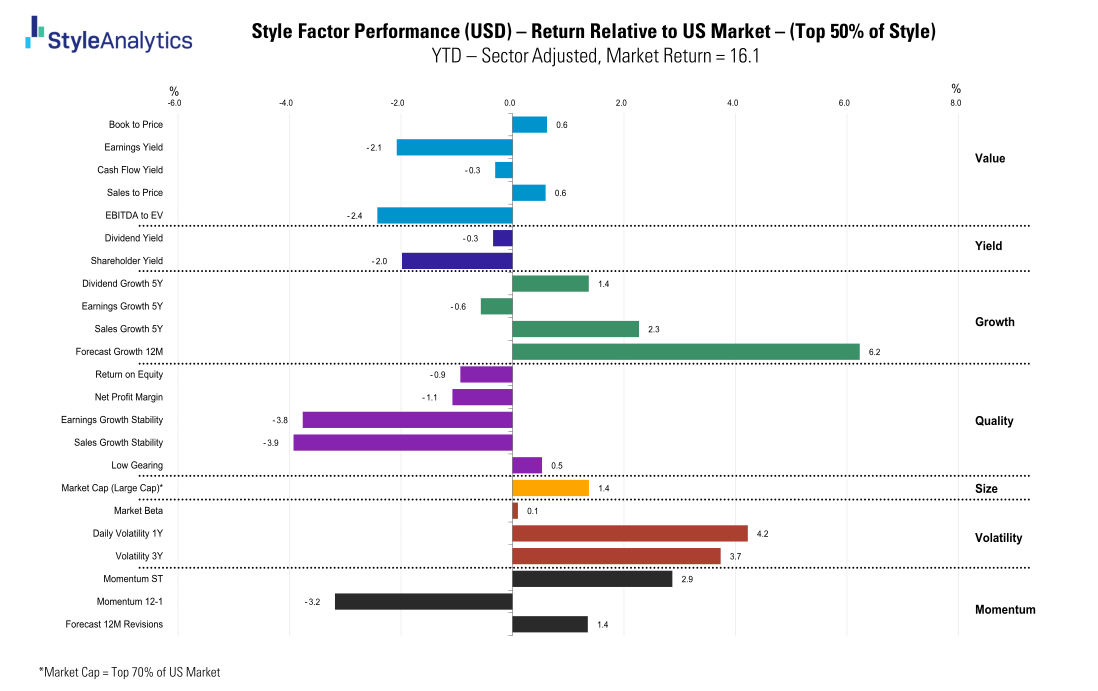
Source: Style Analytics. U.S. Factor Data Ending November 2025. © 2025 Style Research Ltd. All rights reserved. All trademarks are the property of their respective owners. Please see the appendix at the end of the article for additional information about the Style Analytics methodology and Style Factor definitions.
Source: Style Analytics. U.S. Factor Data Ending November 2025. © 2025 Style Research Ltd. All rights reserved. All trademarks are the property of their respective owners. Please see the appendix at the end of the article for additional information about the Style Analytics methodology and Style Factor definitions.
During 2025, investors appeared to favor high-growth and high-volatility stocks, while largely shunning high-quality, higher-yielding, and lower-valued stocks. These trends are largely consistent with sentiment patterns over the past three years and, based on our analysis, were a material headwind to the Fund’s relative investment performance.6
Market Cycle View
| Present Cycle | Present Cycle | Present Cycle | Previous Cycles | Previous Cycles | ||
|---|---|---|---|---|---|---|
| Total Return (Net)* | Peak-to-Trough 1/3/22-10/12/22 | Trough-to-Present 10/12/22-11/30/25 | Peak-to-Present 1/3/22-11/30/25 | Peak-to-Peak 2/19/20-1/3/22 | Peak-to-Peak 10/09/07-2/19/20 | Since Inception** 7/30/03-11/30/25 |
| JENIX | -22.98% | 13.45% | 3.50% | 24.08% | 10.02% | 9.86% |
| S&P 500 Index | -24.49% | 24.83% | 11.19% | 22.37% | 8.73% | 11.16% |
| Difference | 1.51% | -11.38% | -7.68% | 1.71% | 1.29% | -1.31% |
Source: Jensen Investment Management, data as of 11/30/2025.
*Returns are annualized for periods greater than one year.
**The inception date for the Class I Shares was 7/30/2003.
While we are disappointed with the Fund’s recent and longer-term relative underperformance that is shown in the above table, it is important to note that these performance gaps primarily reflect the Fund’s lag during the AI-driven market rally that began in late 2022. Prior to this period, the Fund outperformed over full market cycles,7 as shown in the table above. Accordingly, we expect that relative Fund performance can positively reassert itself when the market environment normalizes.
To read more about our views on extreme market concentration, please see our recent outlook piece, Implications of Index Concentration on Equity Market Return Patterns.
Largest Relative Overweight Portfolio Holdings
| Company | Portfolio Weight | S&P 500 Index Weight | Active Weight |
|---|---|---|---|
| Waste Management | 3.94% | 0.14% | 3.80% |
| Stryker | 3.90% | 0.22% | 3.68% |
| KLA Corp | 3.88% | 0.27% | 3.61% |
Sources: LSEG and Jensen Investment Management. Month-end data as of 11/30/2025.
Waste Management (WM) is the largest integrated waste collection, transfer, and disposal company in North America. Its large active weight in the Fund reflects our confidence in the business. WM’s unmatched landfill and transfer station network creates formidable barriers to entry, supporting durable pricing power and steady cash flows. We view the company as uniquely positioned to enhance returns through landfill gas capture and automation investments that improve efficiency, margins, and long-term profitability.
Stryker (SYK) is a leading global medical technology company with strong franchises across orthopedics, surgical equipment, and neurotechnology. The company has consistently gained market share due to its first-to-market robotic surgery platform and strong execution in ambulatory surgery centers. Furthermore, growth expectations are boosted by secular tailwinds from an aging population and a long runway for international growth.
KLA Corp (KLAC) is a high-conviction holding due to its dominant share in process control, industry-leading margins, and a growing service attachment that drives recurring revenue. As semiconductor complexity increases, KLA’s tools become more critical, reinforcing its “picks and shovels” role in the secular buildout of global computing infrastructure and supporting durable long-term cash generation.
Largest Relative Underweight Portfolio Holdings
| Company | Portfolio Weight | S&P 500 Index Weight | Active Weight |
|---|---|---|---|
| Broadcom | 1.15% | 3.24% | -2.10% |
| Tesla | 0.00% | 2.07% | -2.07% |
| J.P. Morgan Chase | 0.00% | 1.47% | -1.47% |
Sources: LSEG and Jensen Investment Management. Month-end data as of 11/30/2025.
Broadcom (AVGO) is a leading semiconductor and infrastructure software company with strong positions in data center networking and custom ASIC solutions. We own the shares for the company’s favorable exposure to data center investment and differentiated silicon capabilities but remain underweight given stock volatility and our desire to limit portfolio semiconductor concentration risk at current valuations. Neither Tesla (TSLA) nor J.P. Morgan Chase (JPM) qualify for our investable universe due to historically inconsistent returns on equity.
Market Outlook
As a long-term, quality-focused equity manager, our responsibility is to invest in businesses where innovation, scale, and financial strength compound into enduring shareholder value, rather than fleeting market enthusiasm. Our outlook for U.S. equities is informed by external forces, including long-term secular trends and elevated market concentration. Within this environment, our focus remains on businesses with durable cash generation and resilience, rather than those driven primarily by narrative or near-term enthusiasm.
Since late 2022, U.S. equity returns have been unusually concentrated in a small group of mega-cap companies most closely associated with the AI buildout. A handful of stocks — including Nvidia and several large platform and cloud businesses — have driven a disproportionate share of Index returns while much of the broader market lagged. In that environment, investment strategies, such as our own, that were underweight in these market leaders faced meaningful relative headwinds.
Likewise, we deliberately chose not to abandon our quality discipline to keep up with a momentum-driven rally by chasing businesses that did not meet our standards for return on equity. That decision detracted from investment performance in the short run. However, in our view, abandoning a demonstrably successful long-term discipline simply because our investment style is out of favor can destroy far more investor capital over time than a temporary period of underperformance .
That said, the quality investing landscape has evolved. The AI investment cycle is maturing, and, as a result, a growing number of the prominent AI beneficiaries are beginning to meet our quality criteria. Earnings have become more sustainable, returns on capital have been more consistent, and competitive advantages have emerged. Over the past several years, we intentionally reshaped the portfolio to reflect these new opportunities.
Today, the portfolio looks markedly different from the one that entered this cycle. We now own many of the foundational enablers of artificial intelligence and global digital infrastructure, including Nvidia, Amazon, Meta, KLA Corporation, and Cadence Design Systems, alongside long-standing holdings such as Apple, Microsoft, and Alphabet. These investments are not speculative bets on technology hype. Rather, they are highly profitable, cash-generative businesses with dominant competitive positions within global computing, software, cloud, and semiconductor ecosystems.
At the same time, we see compelling opportunities beyond technology and tech-adjacent industries. Many high-quality businesses across Industrials, Health Care, Financials, and Consumer sectors are benefiting from long-term trends such as automation, aging demographics, reshoring, and services-oriented consumption. These companies have received less investor attention but often trade at more moderate valuations, and benefit from clearer pathways to incremental returns on capital, particularly when management teams demonstrate thoughtful reinvestment and shareholder alignment. Importantly, they can also provide stability and resilience should markets become more volatile, valuations compress, or investor enthusiasm fade.
Our positioning is intentional. We believe the portfolio is poised to participate meaningfully in continued growth driven by artificial intelligence and digital transformation, while preserving the resilience that has defined our investment discipline through multiple major market cycles for more than three decades.
That balance has become increasingly important as the market and macroeconomic environment continue to evolve, with earnings growth broadening, interest rates easing, and capital investment becoming more selective. Market leadership is no longer being driven by a single narrative or a narrow group of stocks, and history suggests that in such environments, disciplined stock selection and business quality tend to reassert themselves.
Market concentration in mega-cap technology is a defining feature of the current environment. Our approach is not to avoid these businesses categorically, but to weigh their durability against valuation, capital intensity, and long-term competitive dynamics. Looking ahead, successful investing will require patience and discernment. We remain focused on owning businesses capable of compounding economic value over full cycles, emphasizing quality, cash generation, and resilience as the foundation for long-term shareholder returns.
1 Source: S&P Dow Jones Indices, data as of 11/30/2025.
2 The data discussed in this section reflects the period from 12/31/2024 through 11/30/2025.
3 Source: LSEG, as of 11/30/2025.
4 Ibid.
5 Sources: S&P Dow Jones Indices and Jensen Investment Management.
6 Source: Style Analytics, as of 11/30/2025.
7 We define a full market cycle as one market peak to the next. The current cycle commenced on January 3, 2022, the highest closing price for the S&P 500 Index for the previous cycle. Since that date, the lowest close for the S&P 500 Index occurred on October 12, 2022, and the Index is presently near its all-time high.
Cash Flow: The sum of the after-tax profit of a business plus depreciation and other non-cash charges.
Earnings Growth: The annual rate of growth of earnings typically measured as Earnings Per Share Growth.
Earnings Per Share (EPS): The net income of a company divided by the total number of shares it has outstanding.
Return on Equity (ROE): Is equal to a company’s after-tax earnings (excluding non-recurring items) divided by its average stockholder equity for the year.
S&P 500 Index: A market value weighted index consisting of 500 stocks chosen for market size, liquidity and industry group representation. The Index is unmanaged, and one cannot invest directly in the Index.
Jensen Quality Growth Fund Class I Shares Performance (net of fees, as of 12/31/2025): 1 year: 5.00%, 5 year: 8.10%, and 10 year: 12.40%.
The Jensen Quality Growth Fund I Shares annual operating expense ratio is 0.60% as of 09/30/2025.
Performance data quoted represents past performance; past performance does not guarantee future results. Performance figures shown for periods over one year are annualized. The investment return and principal value of an investment will fluctuate so that an investor’s shares, when redeemed, may be worth more or less than their original cost. Current performance of the fund may be lower or higher than the performance quoted. Click here to view performance information that is current as of the most recent month end or please call 800.992.4144.
Click here to view the Jensen Quality Growth Fund’s current holdings.
Jensen Quality Growth Fund Top 10 Holdings (as a percentage of assets, as of 12/31/2025): Microsoft Corp 10.39%, Apple Inc 8.87%, Alphabet Inc 7.91%, NVIDIA Corp 7.54%, Amazon.com Inc 4.63%, Mastercard Inc 4.57%, Eli Lilly and Co 4.39%, Meta Platforms Inc 4.13%, Stryker Corp 4.10%, and Abbott Laboratories 3.86%.
Fund holdings and sector allocations are subject to change at any time and are not recommendations to buy or sell any security. Current and future portfolio holdings are subject to risk. The information provided herein represents the opinions of Jensen Investment Management, and is not intended to be a forecast of future events or a guarantee of future results, and does not constitute investment advice.
The Jensen Quality Growth Fund is non-diversified, meaning it may concentrate its assets in fewer individual holdings than a diversified fund. Therefore, the Fund is more exposed to individual stock volatility than a diversified fund. The prices of growth stocks may be sensitive to changes in current or expected earnings, may experience larger price swings and may be out of favor with investors at different periods of time. Mutual fund investing involves risk, and principal loss is possible.
The Fund’s investment objective, risks, charges and expenses must be considered carefully before investing. The prospectus contains this and other important information about the investment company. To view the fund’s current prospectus, please visit www.jenseninvestment.com/growth-prospectus or call 800.992.4144. Read it carefully before investing.
Distributed by Quasar Distributors, LLC.
© 2026 Jensen Investment Management
Appendix
Style Analytics Methodology
The Style Factor chart represents a statistical sampling technique to evaluate different factors in the market under value, quality, growth, momentum, etc. Top 50% highest scoring companies (positive or negative) are being measured under each factor. 70% of the largest companies in the index are being scored under market cap factor only, so that mega caps do not skew the result. Sector adjustment is applied so that no one company or industry has an outsized influence, meaning the scores are neutralized to the actual sector weights in the U.S. market as measured by the MSCI USA Investable Market Index for the YTD period from January 2025 through November 2025.
The MSCI USA Investable Market Index (IMI) is designed to measure the performance of the large-, mid-, and small-cap segments of the U.S. market. With 2,190 constituents, as of December 31, 2025, the index covers approximately 99% of the free-float-adjusted market capitalization in the United States.
Style Analytics, Inc., is the source for reports with the “Style Analytics” logo. Jensen cannot guarantee the accuracy of information received from third parties.
Earnings and dividend growth are not measures of future performance. Past performance is not a guarantee of future results.
© 2025 Style Research Ltd. All rights reserved. All trademarks are the property of their respective owners.
Style Analytics Style Factor Definitions
Value Factors
Book to Price: The ratio of the company’s book value (the sum of shareholders’ equity plus accumulated retained earnings from the P & L Account) to its share price. This factor has been one of the most successful measures of the intrinsic value of company shares.
Earnings Yield: Annual earnings (adjusted for amortizations of intangibles, extraordinary charges and credits) per share divided by the share price. This factor measures the worth of a company’s shares according to the company’s ability to support each share with after tax earnings.
Cash Flow Yield: Annual cash flow per share divided by the share price. This factor is related to earnings yield but also includes other items, specifically: depreciation, amortizations, and provisions for deferred liabilities. It is intended to capture the cash availability of the company as a multiple of the share price, and offers a value criteria based on the stream of accessible cash earnings
Sales to Price: Net sales per share divided by the share price. This factor measures the worth of a company’s shares according to the annual sales volume supporting the company business. The item is considered by many analysts to be less susceptible to manipulation than other valuation criteria; it is, however, a less comprehensive measure of a company’s range of activities.
Yield Factors
EBITDA to EV: The ratio of the company’s EBITDA to Enterprise Value. EBITDA is Earnings before interest, taxes and depreciation and is calculated by taking the pretax income and adding back interest expense on debt and depreciation, depletion and amortization and subtracting interest capitalized. Enterprise Value is defined as “market capitalization + total debt + preferred stock – cash and cash equivalents”.
Dividend Yield: The annual dividend paid per share divided by the share price. This factor measures the value of company shares according to the stream of dividend income resulting from share ownership.
Shareholder Yield: The sum of Net Buyback Yield, Dividend Yield and Net Debt Paydown Yield. This factor measures the proportion of a company’s value distributed to shareholders through dividend payments, share repurchases and debt reduction.
Growth Factors
Earnings Growth 5Y: The average annual growth rate of earnings (adjusted for amortizations of intangibles, extraordinary charges and credits) over a trailing five years. Earnings Growth is, perhaps, the clearest of the growth criteria. However, it is subject to the distortions of reporting conventions and manipulation and, particularly in some markets, only known after a considerable lag.
Sales Growth 5Y: The average annual growth rate of net sales per share over a trailing five years. Although growth in sales per share might be only a narrow measure of a company’s business growth, and may be subject to a number of distortions, it is less subject to differences in reporting conventions or manipulation than many other balance sheet or profit and loss items.
Forecast Growth 12M: Consensus forecast growth of earnings over the next 12 months. The 12-month growth is calculated on a pro-rata basis from the forecasts for each of the company’s next 2 annual reporting periods.
Dividend Growth 5Y: The average annual growth rate of dividends over a trailing five years.
Quality Factors
Return on Equity (ROE): Net Income after preferred dividends divided by the book value of shareholders’ common equity. ROE measures the profitability of the operations of the company as a proportion of the total amount of equity in the company. Since ROE multiplied by the reinvestment rate (the proportion of earnings not paid as dividends but reinvested in the company gives the warranted growth rate of a company, ROE is a traditional measure of a company’s growth potential.
Net Profit Margin: The “net margin”, annual net income before preferred dividends (plus policyholders’ surplus for insurance companies), divided by annual net sales. This measure attempts to assess the company’s potential for profitable, sustained expansion or growth.
Low Gearing: The negative of debt to equity. Low geared companies can regarded as being of higher “quality” as they are less burdened by debt repayment costs.
Earnings Growth Stability: This ‘quality’ factor is calculated as the negative of the standard deviation of earnings growth over the most recent 3 years of growth data.
Sales Growth Stability: This ‘Quality’ factor is calculated as the negative of the standard deviation of Sales Growth over the most recent 3 years of growth data.
Size Factor
Market Cap: The market capitalization of the stock. The average size statistic of a portfolio is the weighted (by holding value) average size of the securities held. The average size statistic of a benchmark (or total market) is the weighted (by holding value) average size of the securities within the benchmark (or total market).
Volatility Factors
Market Beta: The “slope coefficient”, (β), from the simple regression: Security monthly return = α + β * market monthly return + random error. The regression is carried out over 36-month periods. Where sufficient information is not available, β=1 is assumed.
Daily Volatility 1Y: The standard deviation of the last year of daily total returns, expressed as an annualized percentage.
Volatility 3Y: The standard deviation of the last 36 months of total returns, expressed as an annualized percentage.
Momentum Factors
Momentum ST: Calculated using a 6 month “memory” of monthly total returns. The past period returns are weighted using a “decay ratio” of 2/3, per month. This weighted historic return factor measures the degree of performance trend following. It is useful in recognizing trading character of specific markets and in noticing occasional changing patterns through the market cycle.
Momentum 12-1: The total return of the stock over the last 12 months, excluding the total return over the most recent month since reversal effects are often associated with one-month returns.
Forecast 12M Revisions: IBES balance of Earnings forecast revisions for the over the next 12 months. Calculated as the difference between the number of upwards revisions minus the number of downwards revisions (as sampled over the past 1M period), expressed as a percentage of the number of estimates. The 12-month earnings revisions is calculated on a pro-rata basis from the forecasts for each of the company’s next 2 annual reporting periods.
Interested in Learning More?
Related Insights
Jensen News & Insights

Portfolio Managers Allen Bond and Jeff Wilson host the 4Q 2025 Jensen Quality Growth Fund webinar, providing insights on the Fund’s quarterly performance, portfolio activity, and market outlook.

View the Jensen Quality Mid Cap Fund’s annual capital gains and ordinary income dividend distributions for 2025.

View the Jensen Quality Growth Fund’s annual capital gains and ordinary income dividend distributions for 2025.

Portfolio Managers Rob McIver and Jeff Wilson host the 3Q 2025 Jensen Quality Growth Fund webinar, providing insights on the Fund’s quarterly performance, portfolio activity, and market outlook.

Portfolio Manager Allen Bond and Business Analyst Kimberlee Millar host the 2Q 2025 Jensen Quality Growth Fund webinar, providing insights on the Fund’s quarterly performance, portfolio activity, and market outlook.